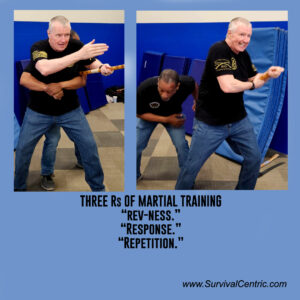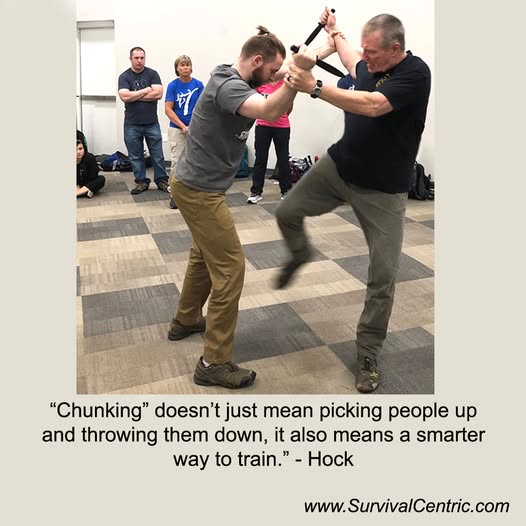
N THE BLINK OF AN EYE. CHUNKING BRINGS THINGS TOGETHER. THANK YOU GEORGE MILLER.
We are on a roll here this month, splitting hairs on the Hick’s law subject. I am quite sure that Hick and Hyman, in the 1950s, never dreamed that their hyper-jump from a “one-task-test-hand” to estimate-attach two, three or more tasks of any kind, in a chart, would be used in hand, stick, knife, gun fighting. After all, their chart suggests-enforces that, for fighting training, you must become a one-trick-pony even though you have the ability to be two or three trick stallions.
Also as an aside to this conversation is the reminder that there are 1,000 milliseconds in a second. So, if something took 500 milliseconds to decide, how bad is that, really? A reference – a typical human eye blink lasts between 100 and 150 milliseconds. Milliseconds in passing are hard for me to grasp, even a second is hard for me to quantify.
Hick and Hyman ended their study in the 1950s with their assigned choice-time dilemma, with no solutions offered. Leaving us astray. Newer, better studies do have some solutions, and that’s why newer studies are so important. But, some folks aren’t so new on this subject at all! Just unknown and-or ignored. And one big one is on what the experts call, then and now – “chunking.” When did it arrive “in the field?” Let’s again look at A.I. for this timetable.
“When Chunking Became a “Good Solution.” Chunking—grouping multiple small actions or pieces of information into a single larger unit—became recognized as a powerful solution for improving human performance beginning in the 1950s, with its scientific foundation solidified in the late 1950s and early 1960s. This George Miller book is often cited as the formal birth of “chunking” in cognitive science.
George A. Miller (1956) – The Breakthrough
• Study: “The Magical Number Seven, Plus or Minus Two”
• Importance: Miller demonstrated that the human brain has a very limited working memory capacity. People manage this limit by grouping information into chunks, which allows complex actions or data to be processed as a single unit. This became the foundational research proving chunking is not just helpful—it’s biologically necessary.
Thanks again A.I. Hick’s Law tells us that more choices slow you down and every extra decision point adds time to your response. Or longer. Mental selections are physical time. (How long is longer in every situation? It may be just milliseconds, though. Depends.)
Chunking is the antidote. Chunking is the brain’s ability to take multiple separate choices and weld them into one single, automatic action. Instead of three choices, you have one. Instead of three decisions, you have zero decision makings. For example, in untrained people a block, strike, and step might be three separate tasks, each requiring its own mental confirmation. But trained fighters merge these into one smooth “burst”—the brain fires off the whole package like a single shot.
1: Block and strike (two steps).
2: Block-strike simultaneously (one step. a chunk.)
3: Block strike and then kick (3 steps, but practiced as one series).
4: Have a few series of more 2-3 steps composed to add-lib.
5: Etc. Etc.
6: Everyone is different by age, strength, size, mental acuity, and potential.
This is the same process musicians use to play a song without thinking of every note, or how drivers shift gears, brake, and turn without mentally verbalizing each step. The brain stores the group as one high-speed motor program. Once chunked, the action bypasses slower, deliberate thinking and moves into the fast lane: reflex-level, sub-cortical, near-instant. Again, even in our everyday lives, we chunk. If we mow the lawn, or take up the piano, cook a meal, we start chunking. We chunk so much, which Law should make a desicion-making priotity lesson? (By the way, the 10,000 reps “rule” has been shattered by research. People are different and need less or more reps, usually less. You can easily look that up.)
In self-defense, chunking turns a long sequence into a single solution. You are not deciding between six blocks or nine strikes or whether to step left or right. You are executing a built-in “package response” you’ve done many times. This shrinks Hick’s Law. Instead of being bogged down by options, you’ve compressed choices into one immediate tactic.
I frequently explain to practitioners in seminars, that I usually go 3 steps deep in responses, anything more and you are in a Jackie Chan movie. These are some of the reasons behind when I say this, rather than bog down the whole class with long speeches. You don’t want 20 technique set options versus a certain hook punch to memorize (some arts do this sort of thing.) You want clusters, chunks you can fire under pressure. This is how athletes and pros of all sorts move so fast, years of chunking their world into simple, reliable action patterns.
The bottom line is simple: The more you chunk, the less you think, and the faster you fight. “Chunking turns choice-complexity into simplicity, and simplicity into speed—the only real cure for the hesitation Hick’s Law warns us about.” (and that’s an A.I. quote again, not me).
Your job is to investigate a lot of things, experiment, and then get your favorites down to suit you. Fit them into chunks as much as possible.
A.I. continues – “In summary, Miller’s concept of chunking is a powerful mechanism for organizing information that makes it easier to process, thereby allowing individuals to manage a larger overall number of options while keeping the immediate number of choices low, thus resulting in faster decision times than Hick’s Law’s.
Hicks versus Miller? Hicks no solution. Miller, solution. The irony to me is…both Hicks and Miller were produced in the 1950s. Miller is smarter and deeper and more real, especially for martial chosing, yet, I presume academia advertised Hicks more? Or didn’t know about Miller? As I stated in earllier essays here, in the 1990s. martial instructor picked Hicks. Instead of throwing the name “Hick’s Law” around, maybe we should throw “Miller’s Chunking Law” around. It;s better, smarter. Yeah, yeah sure, Hicks exists in the “pantheon” but is just a steppingstone to Miller. Miller is way more important to training. Pick one like Miller as your doctrine.