Getting your chosen weapon off of, from, out of your chosen carry sites with your chosen everyday clothing wear is important training. In this generic, free-from-formal art subject, in my four major hand, stick, knife, gun Survival Centric combatives courses’ doctrine, we really worry about…the so-called, quick draw.
Within each course, there are separate training module topics, as well there should be. Within each topic are different citizen, police and the military concerns-methods-responses. The variations are simple. Know-follow the laws and rules of engagement. Crime is crime. War is war. Screw that up and be jailed, and-or sued, and-or dead.
I would like to announce here, for starters, that you pull a weapon to stop violence before it is going to happen and-or while it’s happening. The circumstances must be justifiable. In my Confrontations book I define points like reasonable and prudent decision-making, weapon brandishing, weapon use, etc. One of my BIG training goals is to keep you out of jail.
*In my unarmed course, the hero is unarmed, the bad guy has the knife or any weapon. We work on spotting, countering the draw through presentation to use. (Any actions, must be legally justified, or you are going to jail.)
*In my knife course, the hero has a knife versus any weapon. (The draw, and any actions, must be legally justified, or you are going to jail.)
*In my stick course, the hero has a stick-baton versus any weapon. (The draw, and any actions, must be legally justified, or you are going to jail.)
*In my gun course? the hero has a gun versus any weapon. (The draw, and any actions, must be legally justified, or you are going to jail.)
*******
*In training, weapons must be realistic choices in realistic clothes-uniforms. (I almost beg practitioners to wear their “street” clothes, or security, police-military uniforms, so the carries and draws are real.) Combatives never should train in sport-arts-gym clothes. No, just No! “Comfy” is bullshit. Reduce the abstract. Realistic clothing is especially important when considering draws, pockets, carry sites, sheaths and holsters.
*In the “standing through floor-ground format,” the “3 Elevation Drills”…
Elevation 1: standing or just “up” and moving around.
Elevation 2: kneeling- also seated. (Seated must be explored, especially in quick draws, when and where fights often start.
Elevation 3: floored-grounded. Within this “elevation” commitment we generically refer to all the floor-ground versions as ”rattlesnake drills.” I like to use the two-part, two-word term “floor-ground” as a reminder, if even subliminal, that you will be down and fighting on the various floors and various grounds, both inside-and-outside, in rural, suburban and urban environments. (Certainly not just “urban,” a confusing, marketing misnomer). In short, gym floors, cushy mats and trampoline rings…don’t cut it for “downtown,” office-stores-church-school floors, or Afghanistan. Do the rough stuff first a bit, acclimate, and for further reps, switch over to the softer stuff. But “touch” the rough stuff. Know.
Everything you do standing, you should try-experiment on down to the floor-ground. Experiment. “Parts of Arts” a nice little rhyming jingle, but seek out-train for only realistic “PARTS of arts.” (Unless you define yourself as an artist or sports nut.) This 3 Elevation doctrine point creates the “seamless fighter.” Otherwise, you are one-or-two dimensional, as many martial arts are.
The folding knife worldwide business is approximately a 3 billion dollar a year. A big draw challenge is opening the folding knife under stress. As mentioned, some folder-size knives are switch-blades, some folders have pocket hooks that pop open the blade. Tricks. Most don’t though. (Oh, and don’t squeeze the pocket clip into the folder inside the pocket when first acquiring the grip. It pinches the pocket cloth and slows you down. Try a split-finger acquisition (fingers around the clip. If you do chose a fixed blade, then you have to have a sheath somewhere on your body’s carry site. And Folder? Remember – once your folded knife is opened-unfolded, then it is a “fixed blade.” (The who, what, where, when, how and why of knife selection is a whole other knife-preliminary essay.)
*********
The BIG FIVE: Also, on this knife stress weapon draw subject is what I call “The 5 Why They Don’t Draw-Why They Do Draw,” (sticks and guns too), before, during and after an unarmed fight. I collected this based on the military jargon of DOPE – “Data Of Prior Experiences,” and from experimental training and crime and war. And certainly, from police cases I have worked on and detective-investigation cases I have been taught in annual seminars like “Assault and Violent Death” schools. What are these? Before, during and after. Why they do, and why they don’t? Stats show many people we fight are unarmed. Studies suggest 40% of the people are armed in some way. Studies show about 40% of the time we fight two or more people. These percentages dangerously add up. Drills like this make people realize that during an unarmed fight they still need to watch for such weapon draws as well as fight. (I usually sneak in one round to surprise the trainee with an onlooker to the fight, someone who suddenly draws a knife, a stick, a gun, a chair, and rushes in. It’s messy. Almost and frequently a no-win, ambush situation.
DOESN’T-DOES…Reasons you-he draws are crime, war, fear, anger, revenge and “crazy.” Here are the 5 big reasons for civilian draws to consider…
1-He doesn’t draw: they actually forget they are armed while fighting. Oh yes that happens. We have arrested freshly-post-fight suspects and on a pat-down, found a knife or gun on them. “Why didn’t you use this? “I forgot I had it,” was a typical answer.
2-He doesn’t draw: They are too smart to draw a weapon. Dumb or not dumb, they just “know” it’s not justified. (Police live in this world of controlled suppression (or at least should!)
3-He does draw: Anger. Before, during or even after they start to lose, or lost the unarmed argument or fight, they get angry enough to draw. Especially if they are frustrated and losing.
4-He does draw: Fear. Before, during or even after they start to lose, or lost the unarmed argument or fight, they get scared enough to draw. Especially if they are frustrated and losing.
5-He does draw: But AFTER they won the argument or unarmed fight. Psychologists have called it “dominant fervor” like a victory lap. They won empty-handed, but hate for it to be over and THEN draw the weapon, usually to further celebrate-intimidate-threaten their win and brag.
*Just 5 observations for civilans? What about the military? It should be noted that military people draw their knives for 2 combat reasons. To quietly kill, (duty) and when they have run out of ammo. All inside undefinable mix-levels of duty, fear and anger. Most military people prefer fixed blades over folders for the opening delays. Not everyone is in the military so folders are popular. Otherwise their knives are just as-needed, work tools.
*********
The Draw-Don’t Draw Continuum. In the gun world, we were-are all so exposed to the “Shoot-Don’t Shoot” decision-making. A citizen, police, military…well…dilemma. But there is so much more to the decision steps and training to worry about. This breakdown may help
Decision 1: There-Not There. A big one! Problem-danger spot? Why did you go there? Why are you still there? Be able to explain. Who, what, where, when, how and why you went there and stayed there.
Decision 2: Pull-Don’t Pull (draw-don’t draw). You can draw and conceal the weapon, or draw and display. Or use. (Remember the best-fastest quick draw in the universe is getting your weapon out, just before you really need it. This may border on brandishing, so study the laws on this. Be able to explain your draw. Who, what, where, when, how and why.
Decision 3: Aim-Don’t Aim. Or point the knife, or don’t point. Leave the weapon out and down. In many jurisdictions, aiming-pointing is more serious than just having it out and NOT aiming-pointing. This is often a split-hair evaluation inside police agencies when officers pull their pistol and aim or don’t aim. Be able to explain why. Who, what, where, when, how and why.
Decision 4: Use-Don’t Use. (The classic “shoot-don’t shoot” with guns) Do you stab and slash? Do you pull the trigger? Best be able to explain why. Who, what, where, when, how and why.
Decision 5: Stay-Don’t Stay? Do you remain afterwards? Is there more danger? Do you render aid or not? Do you flee? Call authorities? Not call authorities? Situational decisions to think about, discuss and debate. Be able to explain why. Who, what, where, when, how and why.
*******
Two Knife (and overall) training categories I use. I continue here with my Survival Centric: Knife course that covers stress quick draws. INCOMING! No incoming training? Just hitting, kicking, stabbing, slashing a heavy bag solo, or just like shooting paper targets for bullseyes, does not cut it. Part of it yes. But incomplete, one-dimensional training in for a fight.
Stress Draw Training Category 1: This category organizes some solo and with-training-partners work. It’s about “Isolated Skill Development. Taking-isolating the pieces apart. Getting-being better at each bit. Reverse engineer the common probable knife versus hand, knife versus stick, knife versus knife, knife versus gun-threat fights. Who, what, where, when, how and why? What are the bits and pieces? The elements. What are some of these steps?
-Draw solo, standing through floor-ground, with your chosen knife, from your usual carry site, with your usual clothing. Develop deceptive draws too.
-Draw solo on enemy cues. Still no contact yet (Collision One of the Collision Six). Standing through floor-ground, as your training partner stands before you and gives you his attack-draw cues appropriate enough for you pull the weapon. You MUST have visual, (at times audible) and-or feel-physical stimulus causing you to draw.
-Draw solo and practice some verbal skills. Including threats in a mirror with sufficient command presence that may run-off, scare-off criminals. Numerous FBI stats studies years ago, for years running, declared that some 69% of the time on average, when a criminal is confronted with a knife or gun…they leave. As weak as the FBI stats are and were (collection problems) these stats slowly disappeared through time. Became “political incorrect,” because they suggest-support weapon carry. Therefore no longer published. World governments prefer a pussified, weak, victim-based, unarmed populace. For all the obvious reasons.
-Some suggested stress draw, small “vignettes” of situations,
* Draw on enemy cues.
* You push him away and draw. Threaten. Then you push him and he charges right back at you as you draw. Freestyle struggle.
* He grabs you and draws. You release the grab or draw, or you remain grabbed and draw. Struggle with this.
* He trips-knocks you down and draws a weapon, you draw on the floor-ground. Threaten. Or deal with him, unarmed or armed, jumping on you. Get up ASAP.
* Both floored-grounded, you draw through my Knife Rattlesnake Drill series list.
*Learn and run the “Solo Command and Mastery” of stabbing and slashing, saber AND reverse grips, based on the Combat Clock, standing through ground. Solo (in the air) and against training devices for the feel of impact.
*Continue inventing situations…
Stress Draw Training Category 2: All with partners. Stress draw combat scenario training, standing through ground, based on the Collision 6 combat scenarios: Draws can occur in all six collisions, and not in any particular order. The fight might begin in Collision 4. Experiment by stress drawing through the common fight collisions (yes,it’s the old “Stop 6” program format with now…a newer, friskier, sexier name). INCOMING! No incoming training? Just hitting, kicking, stabbing, slashing a heavy bag solo, or just like shooting paper targets for bullseyes, does not cut it. Part of it yes. But incomplete, one-dimensional training for knife (and hand, and stick and gun) fighting.
-But first, Some training partner, suggested stress draw, small “vignettes” of situations,
* Draw on enemy cues.
* You push him away and draw. Threaten. Then you push him and he charges right back at you as you draw. Freestyle struggle.
* He grabs you and draws. You release the grab or draw, or you remain grabbed and draw. Struggle with this.
* He trips-knocks you down and draws a weapon, you draw on the floor-ground. Threaten. Or deal with him, unarmed or armed, jumping on you. Get up ASAP.
* Both floored-grounded, you draw through my Knife Rattlesnake Drill series list.
*Continue exploring, reverse engineering the bits and pieces, parts and situations…
Then the Collision 6
Draw Collision 1: Draw during no contact-collision (a collision of the minds if you will.) To some kind of non-contact finish (successful threats or other verbal skills, orderly retreat, etc.)
Draw Collision 2: Draw during hand contact-collision. Many times the first contact-collision wave, is at the hands. Hands on hands, hands on wrists, hands on weapon carry sites, hands on weapons like sticks and gun. (Don’t grab the blade!) To some kind of finish. Experiment.
Draw Collision 3: Draw during forearm contact collision. To some kind of finish. Experiment.
Draw Collision 4: Draw during extended arms to shoulders, neck, biceps contact-collision. To some kind of finish. Experiment.
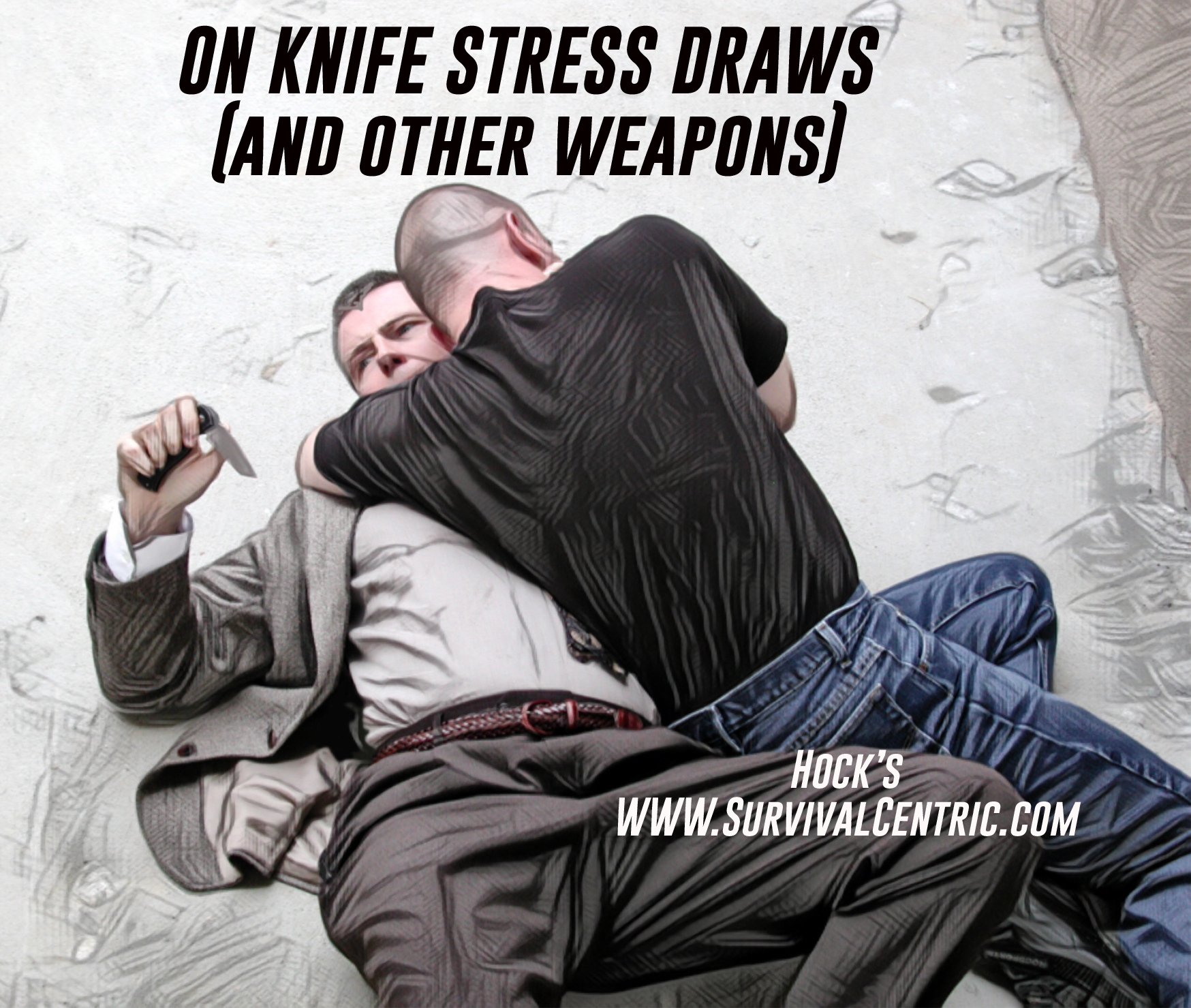
Draw Collision 5: Draw from “bear hugs” (all his arm double arm wraps of you: his chest to your chest, his chest to your back, his chest to your right of left shoulder, all his leg wraps like picks and tackles. Also during his various chokes and guillotines on you. To some kind of finish. Experiment.
Draw Collision 6: Ground zero. Anything on the floor-ground. Resembling the Collisions in 2, 3, 4, 5, but horizontal, not vertical! To some kind of finish. Experiment.
For “after the draw” training, learn and run the “Solo Command and Mastery” of stabbing and slashing, saber AND reverse grips, based on the Combat Clock, standing through floor-ground. Solo (in the air) and against training devices for the feel of impact. Then training partner practice. Insert these into combat scenarios, )Oh, saber and reverse grips. Don’t be a naive fool and ignore one of the two main grips. It’s like going into a fight and having your pistol half loaded with ammo.)
By doing all these things you experience a lot. A lot of reality problems. Your reality knife fight will suck. All violence is a drama and trauma. The knife carries a horrible, public stigma that will sting you with responding cops, prosecutors, and in the courts of public opinion, the courts of crime and civil. Be justified and legal. Buckle up. In the military, one should not violate the rules of engagement.
And there you have it. Parts 1-4, the skeleton to flesh out from which I have built my Survival Centric: Knife course quick draw subject (and by the way stick and gun draws). This was devised in 1996. Still tweaked since, from epiphanies.
By W. Hock Hochheim