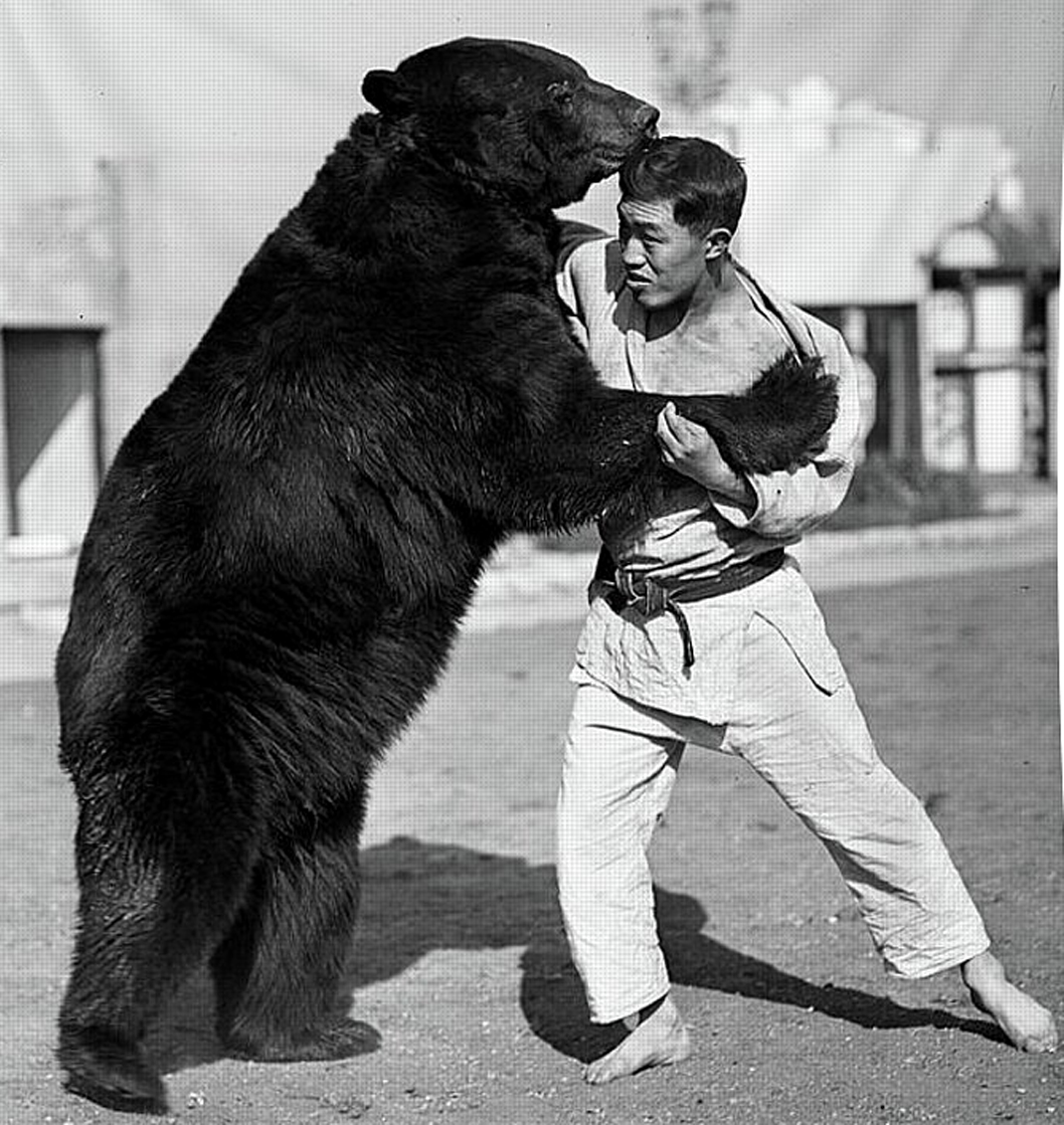
Found often under the old circus and carnival sections called “Monsters of the Midway.” There was a time in America when a man could walk into a dusty fairground, hear a barker shouting over the crowd, and watch another man step into a ring with a bear. Not a story. Not a movie. A real bear. And for a few dollars, folks stood there eating popcorn, watching what they thought was a fight.
There is nothing casual about standing within arm’s reach of an animal that can tear a car door off its hinges. But back then, it was packaged as entertainment. A stunt. A challenge. Something between a circus act and a barroom dare. They called it bear wrestling. Now, if you picture two creatures squaring off in some fair contest, shake that idea loose right now. These weren’t wild, free animals. These bears were controlled—declawed, sometimes muzzled, trained, and handled in ways most people in the crowd never saw. The
It’s widely believed that bear wrestling started in the German and barbarian clans. Wrestling bears in Russia is something of legend. Kids would wrestle young bears while being watched by handlers. Young bears are usually playful and will roll around without posing a serious threat. Still, they are unpredictable, and the idea was frowned upon by many. The adult-bear matches had choreography to them, sure, but that didn’t make them safe. You can’t choreograph instinct. You can’t script muscle and bone and animal reaction.
You slip once, you’re not in a performance anymore, you’re in a survival situation. That’s the part people didn’t understand. Or maybe didn’t want to. Traveling carnivals pushed this stuff hard through the early and mid-1900s. There was even “Last five minutes with the bear, win cash” offers. That kind of thing. And you’d get takers. Always. There’s never been a shortage of men willing to test themselves against something bigger, meaner, and stronger. Pride is a powerful motivator. So is a crowd. What we do know, from scattered reports and firsthand accounts, is this:
- Some men did last the time limit, especially if the act was controlled and semi-choreographed.
- Experienced performers usually survived, because they understood the real goal was endurance, not dominance.
- Untrained challengers were at much higher risk, and often got roughed up quickly.
But here’s the key point that cuts through the myth. Those contests were often structured, so survival was possible, but never guaranteed. The bear was typically conditioned, sometimes limited physically, and the handlers stayed close. That increased the odds that a man could last a few minutes if he stayed tight and didn’t panic. In that sense, yes, people “survived” those five-minute challenges.
But behind the canvas and sawdust, the reality was different. Handlers stayed close. Chains were sometimes just out of sight. The animal had been “prepared.” And the wrestler, if he was smart, wasn’t trying to beat the bear. He was trying to survive it. Stay low. Stay tight. Don’t get caught in the jaws. Don’t get thrown.
In some cases, bears were drugged, but it was never as simple or reliable as people might imagine. The idea of giving a bear something to calm it down sounds straightforward, but in practice it was unpredictable and often secondary to other forms of control. Even with all of that in place, fatigue, restraint, and sometimes sedation, the core reality never changed. The animal was still immensely strong, still capable of sudden reaction, still unpredictable in ways no handler could fully control. The system worked just well enough to keep the show moving, most of the time.
But, even then, people got hurt. Broken ribs. Torn shoulders. Internal injuries that didn’t show until later. And every now and then, worse. Because no matter how much control you think you have, you are still dealing with an animal built for power, not performance.
Over in parts of Russia and Eastern Europe, they had their own versions, more traditional, more choreographed, but still built on the same uneasy foundation: human control over something that doesn’t naturally belong in a ring. And eventually, the world caught up with the reality of it. Laws changed. Public attitudes shifted. People started seeing not just the danger to the man, but the cruelty to the animal. The old acts faded out. These days, you’re more likely to see acrobats and stage lights than claws and teeth under a tent.
And that’s probably for the best. Still, when you look back at it, there’s something telling in those old shows. Not admirable, but revealing. They say something about risk, about ego, about the way people will dress up danger and sell it as spectacle. Because at its core, bear wrestling wasn’t really about the bear. It was about the man stepping into the ring. And what he was trying to prove. People like to imagine that a man wrestling a bear meant grabbing hold, squaring up, and controlling the animal the way one man might control another. That idea sounds clean, almost technical, like there was some method, some system behind it. There wasn’t. What actually happened in those rings was much rougher, much closer to survival than skill.
The bear was usually brought upright, trained to stand on its hind legs so the whole thing looked like a fair contest. Man against man, at least from a distance. But that position, the one that made the crowd cheer, was also the most dangerous one. A standing bear has reach, weight, and the ability to strike downward with crushing force. The illusion helped sell tickets, but it did nothing to make the situation safe.
If the man had any sense at all, he went low right away. He stayed under the bear’s chest, kept his head tight to the body, and tried to crowd in close. Distance was the enemy. Space is where the bear could swing, swipe, and generate power. So, the man closed that space and stayed there, not to dominate, but to limit damage.
People talk about grabbing the arms, but that is not really what was happening. You cannot control a bear’s arms the way you can control a person’s. What the man did instead was hook around the shoulders, press into the torso, grab whatever he could, fur, loose hide, anything that gave him a hold. It was not about control, it was about contact. Staying connected so the bear could not get a clean “shot” at him. That was the whole game. Do not get hit clean. Do not get thrown. Do not get separated.
Because if the bear got even a moment of space, the balance shifted instantly. One good swipe, even without claws, could break bones or knock a man flat. One solid shove could send him to the ground, and once he was down, things got worse fast. So he stayed tight, rode the movement, let the bear push and pull while he hung on and tried to outlast it.
Most of these matches were timed anyway. The man was not there to win in any real sense. He was there to endure. If he lasted long enough, he proved something, at least to the crowd. But underneath it all was a simple truth. No matter how trained the bear was, no matter what had been done to limit its claws or bite, it was still an animal built for power. Hundreds of pounds of muscle, bone, and instinct. The man in that ring was not controlling it. He was surviving contact with it.
And that is the part that tends to get lost when people look back on those acts. It was never a fair fight. It was never really a fight at all. It was a man stepping into something bigger than him, closing the distance, and holding on, hoping it ended before something went wrong.
Things did go wrong sometimes…on the crowd… It did not happen every night, but when it did, it followed patterns that were as predictable as they were dangerous. The risk was never contained inside the ring. It sat right there with the crowd, quiet and unnoticed until something slipped.
The biggest danger was simple. The bear got loose. Chains slipped or broke, a handler lost control for a moment, the animal reacted to noise, light, or stress, and suddenly the thin line between show and chaos disappeared. When that happened, there was no performance anymore. There was a bear moving through a crowd that had no real barrier, no real plan, and no time to react.
People ran. They ran in every direction at once. Some tripped over benches or ropes, others stumbled over children or each other. Many never came close to the bear itself, but they still got hurt. Panic has a way of doing damage all on its own.
The ring, if it could even be called that, was never much of a boundary. It might have been a rope line, a few barrels, or just open space that people agreed not to cross. Spectators stood only a few feet away. They leaned in for a better look, lifted kids onto their shoulders, pressed forward as the action heated up. There was very little separating them from what was happening in front of them.
So, when things shifted, the danger moved fast. A bear turning suddenly, lunging, or pushing forward could spill straight into the front row. A man getting thrown could crash into the crowd. Handlers rushing in to regain control could shove people aside without warning. In a space that tight, it did not take much for the action to spill over.
Then there was the force of it all. When a bear and a man collide, the energy does not stay contained. A swipe could send a man sliding or rolling outward. Props, stools, or anything loose in the ring could be kicked or knocked aside. Even the tools handlers carried could swing wide in the confusion. A person did not have to be the target to get hurt. They only had to be close.
What made it worse was the way crowds behave under sudden stress. Some people froze. Others rushed forward instead of back. A few tried to step in and help, only to get in the way. And once that panic started, it built on itself. One person fell, another tripped over them, and suddenly there was a pile of bodies where there had been a clear path just seconds before.
That was where many of the injuries came from. Broken bones, trampling, people crushed under the movement of the crowd. Not from the bear itself, but from everything that followed when control broke down.
Most of these incidents never traveled far beyond the towns where they happened. A short mention in a local paper, a story passed around, then forgotten. But the pattern never really changed. The act depended on control, and control was never absolute.
The crowd believed they were watching danger from a safe distance. In truth, they were standing right beside it. And when that thin layer of space and assumption gave way, it was not just the man in the ring who paid the price. It was anyone close enough to be caught in it.
“If it’s brown, lay down; if it’s black, fight back; if it’s white, goodnight”. A widely cited, though debated, guideline for different bear species. Hunters and animal researchers never mentioned the term…wrestling.
Get Hock’s newest Gunther western adventure. Click here for the ebook or the paperback