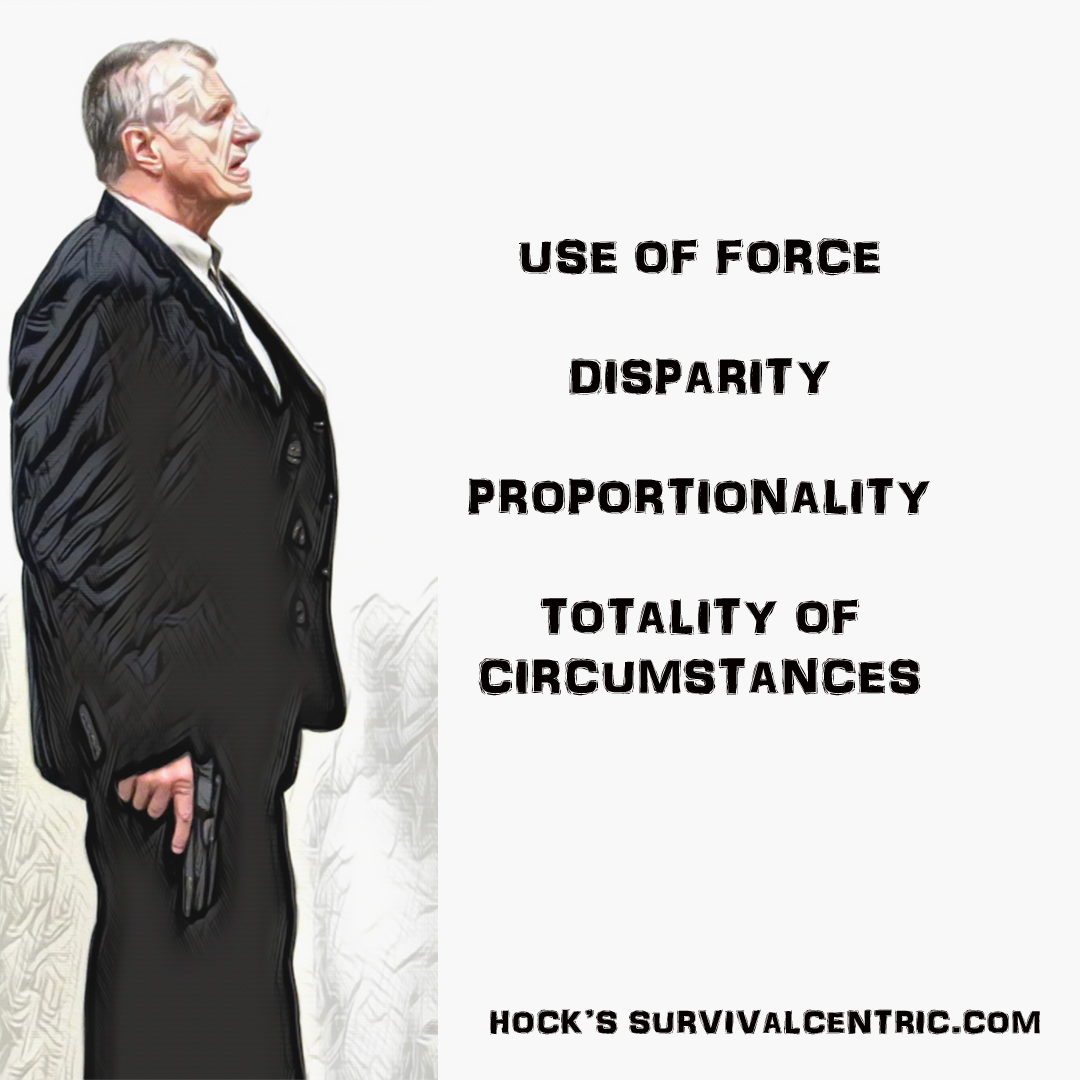
A very important part of my martial-combatives job is keeping people out of jail, out of courts and military tribunals. Any serious discussion of self-defense, crime and war must begin with four foundational, legal concepts: the “use of force,” “disparity of force,” “proportionality” and the “totality of circumstances.”
These principles form the legal and practical framework by which actions are judged after a violent encounter. They are not abstract theories. They are the standards-concepts by which the best police, prosecutors, juries, the public and the militaries of civilized countries will evaluate what you did, and why you did it. sadly it may come down to the supreme courts of each state and then even the Federal, to get the right answers. ($$$$)
Use of force refers to the level of effort or action a person uses to stop a threat. It exists on a spectrum, ranging from verbal commands and avoidance to physical control, to the use of deadly force. The central issue is not whether force was used, but whether the level of force was reasonable under the circumstances. A defender must be able to explain, in simple terms, why the force they used matched the threat they faced. Use “only that force necessary.”
This leads directly to disparity of force, one of the most misunderstood but critically important doctrines in self-defense law. Disparity of force recognizes that a person does not need to be armed with a conventional weapon to present a deadly threat. An “unarmed” attacker can still cause death or serious bodily injury when there is a significant imbalance in power or circumstance.
Disparity of force exists when the attacker’s advantage effectively turns their body into a lethal weapon. This advantage can take many forms:
•Force of numbers, where multiple attackers overwhelm a single defender
•A significant difference in size or strength
•Specialized skills, such as training in combat sports or martial arts
•Physical limitations, where age, injury, or disability places the defender at a disadvantage
•Positional dominance, such as being pinned, knocked to the ground, or having one’s head driven into a hard surface
•Gender-based disparities, often cited when a male attacks a female due to general physical differences.
•The law may recognize that a higher level of force, including deadly force, can be justified because the threat itself has been elevated.
•Courts commonly evaluate these situations using three key elements, often summarized as 1: Ability, 2: Opportunity, and 3: Jeopardy. Ability: Does the attacker have the power to cause death or serious bodily injury? Opportunity: Is the attacker in a position to immediately use that power? Jeopardy: Is the attacker acting in a way that places the defender in immediate danger?
We come to proportionality, the principle that the level of force used in defense must be proportionate to the threat faced. This does not mean equal force. It means reasonable force. The law does not require you to fight fair. It requires you to survive within reason.
When an attacker is armed, proportionality often becomes clearer. A weapon such as a knife can create an immediate deadly threat, and responding with a firearm may be considered a reasonable act to stop that threat. In this sense, the defender is not escalating the situation but equalizing it.
However, proportionality is always judged through the lens of reasonable belief. The defender must be able to articulate why they believed the threat was capable of causing death or serious bodily injury. Not every object, and not every situation, will meet that threshold. A small knife at a distance may be viewed differently than the same weapon at close range with aggressive intent.
The legal phrase “totality of the circumstances” is the cornerstone thinking of constitutional analysis in U.S. law, especially as developed by the Supreme Court of the United States. Rather than relying on rigid, mechanical rules, the Court often evaluates a situation by looking at all relevant facts and context together to determine whether government action, especially by police, was reasonable under the Constitution. In short….the situation.
This approach is most commonly applied in cases involving the Fourth Amendment to the United States Constitution, which protects against unreasonable searches and seizures. Instead of asking whether one single factor justifies a search or arrest, the Court asks whether the combined weight of all circumstances would lead a reasonable officer to believe that their actions were lawful. This includes factors such as behavior, location, timing, officer experience, and any observable evidence.
A leading example is Illinois v. Gates, where the U.S. Court rejected a strict checklist (the earlier Aguilar-Spinelli test) for evaluating informant tips and replaced it with a totality approach. The Court held that even if individual pieces of information are weak on their own, they may collectively establish probable cause when viewed together. This marked a shift toward flexibility and practical judgment.
Similarly, in Terry v. Ohio, the U.S. Court upheld a police officer’s right to stop and frisk a suspect based on reasonable suspicion derived from the full context of observed behavior. The decision emphasized that officers must make quick decisions based on unfolding circumstances, and courts should evaluate those decisions in light of the whole situation, not isolated facts.
In essence, the “totality of the circumstances” test reflects the Court’s recognition that real-world situations are complex and cannot always be reduced to simple formulas. It allows judges to weigh the practical realities of human behavior and law enforcement, balancing individual rights with public safety. While this flexibility can make outcomes less predictable, it provides a more realistic framework for assessing reasonableness in a wide range of legal contexts.
Finally, the overall situation, the “totality of circumstances” is a big study. What was the big picture, the whole situation? What if you shot a smaller, older unarmed man? Legal trouble? What if that man was part of four unarmed angry men attacking you? Less trouble. If you used only that force necessary to stop them.
When all four are present to review, a reasonable person may conclude that the threat was both real and imminent. It is important to understand that weapons are not the sole measure of danger. A person does not need to be armed with a gun or knife for deadly force to be legally justified. If disparity of force is present, the law may view the situation as life-threatening even when no traditional weapon is involved.
In the end, these four principles work together. Use of force defines what you did. Disparity of force explains why the threat was serious. Proportionality determines whether your response was justified. Totality of circumstances determines the big picture of what happened.
Every act of violence is both a trauma and a drama. Understanding these four seriously is not optional in the hand stick, knife, gun, civilian, police and military world. It is essential. Because in the aftermath of violence, your actions will be measured by whether a “reasonable” person would have done the same in your place, your predicament, your exact situation.
(Which leads us to 1: moral, 2: ethical, 3: legal. Which is…another story…)